
An open-weight AI model is one whose trained weights you can download and run on your own servers or devices, instead of renting access from a provider. For Indian enterprises, this means prompts and documents can stay inside your own controls, which supports your DPDP Act obligations. The Act’s main business duties start in May 2027.
What is an open-weight AI model?
An open-weight model publishes its “weights”, which are what the model learned during training. Think of them as the finished dish. The recipe, meaning the training data and code, usually stays with the maker.
With a closed model, you rent access through the provider’s service. With an open-weight model, you run it in your own kitchen: your servers or your secured devices. That one difference decides where your data goes.
Open-weight vs closed vs open source
- Closed (GPT, Claude, Gemini): runs only on the provider’s servers.
- Open-weight (Mistral, Gemma): you can download and run it, but you cannot rebuild it.
- Open source (OLMo): shares the weights, training code and information about the training data.
Most models called “open” are open-weight, not open source, going by the Open Source Initiative’s definition of 28 October 2024. Check the licence too, as some add usage limits.
Is your team already using AI you have not approved?
Probably. Employees often use AI before IT approves it. This is called shadow AI, and pasted text often holds customer names, contract terms and staff details. In a ManageEngine survey of 700 respondents, 70% of IT decision-makers had found unauthorised AI use. In a BlackFog survey of 2,000 workers, 49% had adopted AI tools without employer approval. Both surveys are global and vendor-run, so read them as a direction.
What does India’s DPDP Act mean for AI?
The DPDP Act makes it expensive to lose control of personal data. Its main business duties start in May 2027 (12 May, per AZB & Partners; some firms cite 13 May). They include security safeguards and breach notice. Penalty ceilings reach ₹250 crore for failing to take security safeguards, according to Konfirmity.
Residency is where data is stored; sovereignty is who holds legal and practical control. A Mumbai server can satisfy residency yet fail sovereignty if a foreign provider controls it.
Does on-device AI make you compliant? No. It removes one transfer to a provider’s servers, but notice, consent and security duties still apply.
Is running AI locally cheaper?
Not always. Cloud AI is billed per token, a small piece of a word. Prices per token have fallen, yet bills have grown. Analysis cited by Spectro Cloud puts enterprise generative AI spending 3.2 times higher, from $11.5 billion to $37 billion, while token prices fell about tenfold. Enterprise DNA found self-hosting cost more than the API at normal usage, paying off only above 50 million tokens a day or for compliance. So local AI is usually about control first, savings second.
What hardware do you need?
Small open-weight models run on devices your staff already use. Microsoft says a Copilot+ PC with a 40+ TOPS NPU can run many AI tasks locally. The largest models need about a terabyte of memory, which most tasks do not require.
Where should you start?
Start where data is most sensitive and tasks are routine: banking and insurance, healthcare, and HR, legal and finance teams. Good first tasks are summarising notes, drafting replies and answering questions across internal files.
The hybrid answer: cloud for scale, local for control
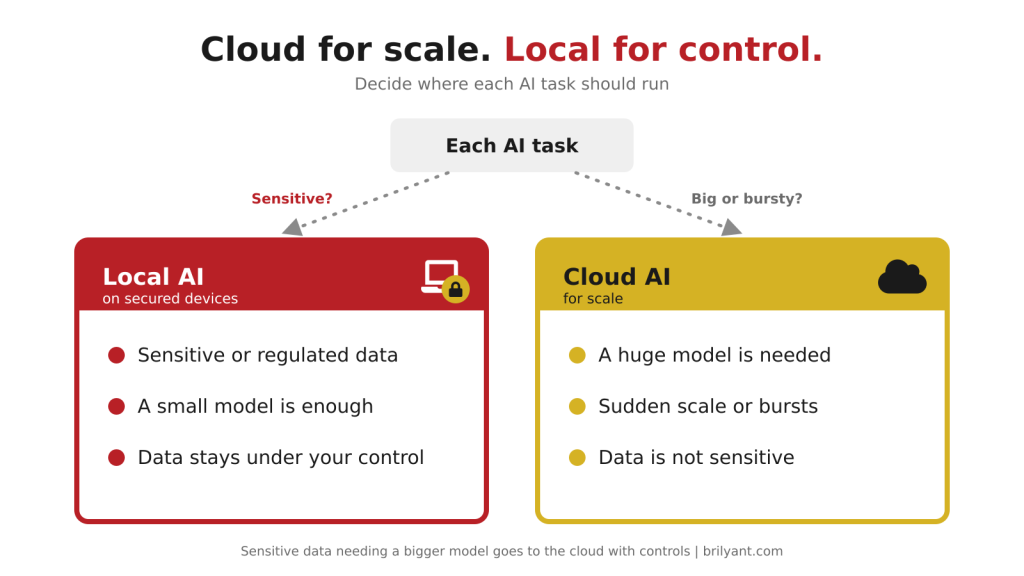
Use a simple test for each task:
- Sensitive data, small model enough: run it locally on a secured device.
- Sensitive data, bigger model needed: use the cloud with controls such as contract, region and logging checks.
- Not sensitive, huge model or sudden scale: use cloud AI.
- Not sensitive, neither applies: choose the cheaper or simpler option.
A four-step rollout
- Find the AI tools your teams use and the data going into them.
- Sort each task using the test above.
- Pilot one routine task with one team on secured devices.
- Govern: set who may use what, manage the devices, and map controls to DPDP duties before May 2027.
FAQ
Are open-weight models safe for sensitive data? They can keep prompts inside your own walls, but you must secure and manage the device and the model.
Run AI on devices you control, with Brilyant
Local AI only works if the devices behind it are secured, managed and kept up to date. That is what Brilyant does. Brilyant’s managed device services help Indian enterprises choose, deploy, secure and manage the devices that run AI locally. Talk to Brilyant about a managed-device plan for your first pilot at www.brilyant.com.